‘Free, and Playable on a Potato’: A Conversation with Cecile Richard
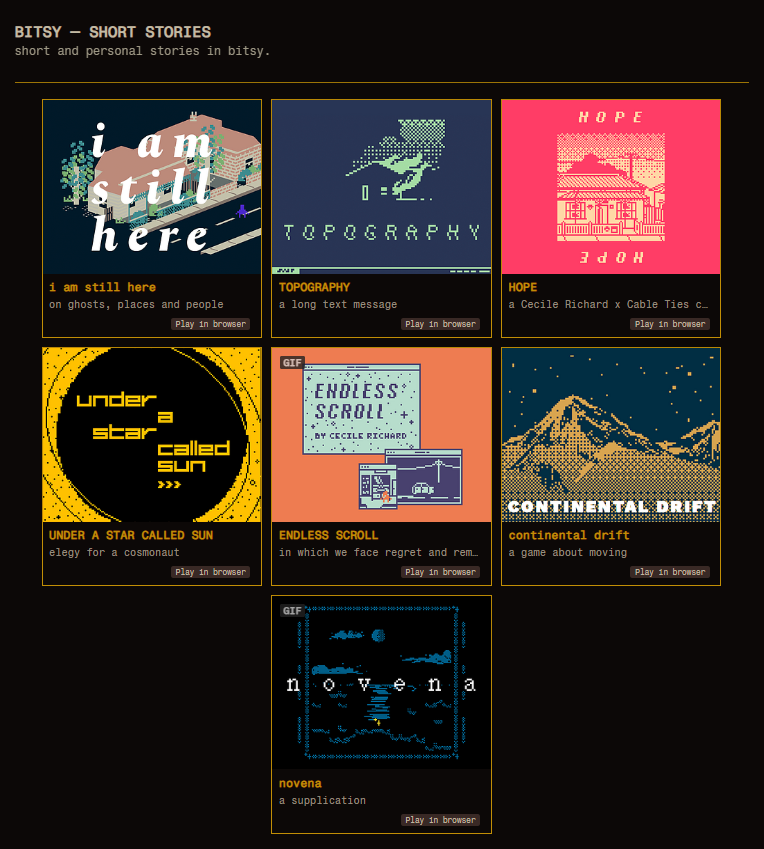
As part of Voiceworks Online’s first issue of 2026, EdCommer Bronte Lemaire sits down with digital storyteller (and former Voiceworks designer) Cecile Richard, to talk about Bitsy games, hosting award shows in the Discord server, the joys of faking archival text, the pros and cons of player choice, and more.
Starting off, how would you describe yourself?
My name’s Cecile and my usual bio is ‘I make cool things on the computer.’ That really describes everything you need to know. I make a lot of narrative focused games, visual storytelling and such things. I used to do comics as well, so I’ve always been into sequential storytelling. I kind of do a bit of everything.
I feel like a lot of writers are like ‘Yeah, I always wanted to be a writer!’ But I’m like nup, not at all. I think I just fell into it, I fell into everything. The me that you see now is the result of many accidents. Being carried around and by life. I was never quite sure of what I wanted to do, and digital work is kind of the ultimate form of that. Maybe next year I’ll do something else…
But digital storytelling has stuck around?
It’s stuck around, yeah. I’ve always been someone who enjoys drawing and stuff, so a lot of my interest came from the visual side. I decided to study graphic design after graduating high school. I was like, ‘Well, I don’t know what to do, let’s try this thing.’ I was in Switzerland at the time, which turned out to be a pretty good place for it.
I also got introduced to indie games—a lot of artsy, very small video games made by one person or three people or whatever—around 2013–14. At the time it wasn’t commercial, it was a very new thing, just like artists pursuing making games. I was just soaking up as much as I could, from video games, and from comics—stuff that was popular on Tumblr, by people like Sam Alden, who were really influential at the time and went on to work on Adventure Time and stuff like that.
Then I graduated graphic design school and started working full-time as a grunt in a design agency, doing ad campaigns and things. And I hated it. And once I realised that I probably should do something about it, I quit my job and started travelling. I started visiting all these people I knew from Tumblr who lived in other countries. In 2017 I spent a month in Melbourne, and I just really enjoyed it. I was sick of Switzerland. So, in 2018, I moved here.
I met my current partner, who was a game designer. I already had a lot of friends in games, so I was already adjacent to that world. He encouraged me to make my own stuff. Then Candle, who’s one of my friends, made a game in Bitsy, and I was like, ‘What the fuck is this? It’s so cool!’ I tried tinkering with it a bit, but I gave up. A few months later, there was this Bitsy jam happening—the theme was ‘Ocean’. I was like, ‘Oh, I really like that theme, I have this idea and it’s way simpler: I could write a poem. That’s easy.’ That entire game, novena, took three days to make—which is kind of crazy to think about, considering how popular that game is now, in a very niche way.
novena is certainly up there in the Bitsy tag [it is the top game]. What was it like having your first step into game making go so well?
At the time I really didn’t consider myself an artist at all, I was just doing things for fun and I didn’t really want to put a name on it. And that changed. I was very sensitive about what it means to get attention and how that effects what I make. In my first year of making games, I was just making a lot of excuses for myself. I remember a talk I did at the time, and it was, ‘Oh man, what am I doing?’ Being a little bit coy about what I’m making, and being like, ‘Don’t we all have imposter syndrome?’ But I didn’t, not at all. I still don’t. Like, I do not believe in imposter syndrome. But I felt like I had to pretend, like I had to be dealing with the attention that people were giving me in a way that felt palatable.
Like not egotistical?
Yeah, exactly. You don’t want to be too weird about it, but also, by not being weird about it, you become weird about it. I think at some point, probably around the time of Under a Star Called Sun, I just decided: ‘Okay, I can probably call myself an artist and it doesn’t sound weird.’
For my second game [continental drift], I was like, ‘Ugh, what do I do? How do I follow this [novena] up?’ I just made this really personal game, probably the most personal game I’ve made. Comparatively, it flopped. The actual making of it, behind the scenes stuff, I still think is very interesting and fun. For continental drift I was thinking of making this zine, compiling all the floor plans of the places I had lived in. And honestly that probably would have been fine. But I wanted to take it further.
The trepidation that you get from imagining how something’s going to be received, ‘Will people like it? Blah blah blah’—I couldn’t care less now, but at the time it was so important, and I just felt really embarrassed to care about that as well. So it was a lot of learning of how to be okay with making things in general, and with sharing them.
Do you feel like when you moved away from that, the work you did got better?
Yes. Absolutely. What saved me was doing Endless Scroll. I don’t think that’s an exaggeration. For that one, Rory Green—lovely person, and editor of Voiceworks Online at the time—they reached out to commission me. And I think the fact that Rory was always there, very supportive as an editor, helped me recalibrate my relationship to making art: to think of it as work, as this thing that you put effort into—that you don’t just have an idea and make it, you actually have to iterate on it. It’s very easy to be kind of like, ‘Why should I do that? Isn’t the purest form better?’ Like no, it’s not.
It was so refreshing—it made me believe in myself again as an artist, as a person that wants to work on things, and it also completely renewed this sense of how important it is to work with other people.
What made you move on from Bitsy to Interactive Fiction?
I think I just wanted more text. I was like, ‘I’m running out of space!’
The dialogue box can only fit so much.
Yeah, exactly. My ideas were getting too complicated for Bitsy—Star Called Sun had so many rooms, it started breaking. I was using this tool to make something it’s not really meant to be used for.
So yes, ( C Y C L E ) came around. That was a really good exercise in: ‘Can I write prose that is interesting to read, even it’s literally just a page that you scroll?’ I think the results are quite good, I’m happy with it.
Can you tell me a bit about Domino Club?
It’s this closed group of people—we’re all friends from the Bitsy era. One of the people, Emma, was like: ‘I have this idea for a jam, do we want do this?’ And the idea for the jam was that we would all make games following a theme, and publish them anonymously, so that nobody would know who’d made what until we revealed it internally, at our awards show in the Discord. You’re free from the threat of being perceived, so you have way more freedom in terms of what you want to express and how.
Every award is like this really really specific thing, and we all celebrate each other’s games—it’s really fun. And what I love about it is that it reinforces this notion that everyone here is engaging with the work to its fullest, because then you have this meta that is born out of doing the jam multiple times. People will try to imitate other people's styles—we call it ‘stylejacking'.
It’s play, right? The way that we interact with each other becomes ingrained in the work, which is pretty novel.
Some of the Bitsys were collaborative, but most of them were solo work. What was it like moving to doing things collaboratively with interactive fiction pieces?
Obviously with different people you have different ways of collaborating. With Sudden Death, my friend Nat and I cowrote: there are chapters I did, and chapters she did. We had a call to figure out what we wanted to make. Like, ‘Here’s what I want to do, here’s what I don’t want to do.’
With Neurokino Retrograde, I was like, ‘Hey Freya, I’ll do some editing if you want but I don’t want to write,’ and she was like, ‘Yeah cool, let’s work this out.’ And it was really good that I didn’t write, cause as she added more stuff into the game I discovered more things and was like, ‘Oh it’s going that way?’
For both THE DEVIL’S IMAGO and GUTLESS I collaborated with my friend John. We have a great way of collaborating where we have the same brain, so match each other’s freak in that sense, and are always yes, and-ing each other.
Even in projects I'm basically spearheading, it's been important to learn to defer and say, ‘Hey, I don’t know what to do here,’ and ‘What do you think?’ That I learned from the Rory era. And that’s kind of my job now, ’cause I’m writing for a game, an actual commercial game with Ghoulish, Parasensor, which means I have to work in a team.
Games are such a collaborative process in general, even on the basic software level. A lot of the stuff I use is stuff made by other people made by some guy or stuff made by my friend. Everything is the result of multiple people working on something. I think that’s a really good thing for the art.
There was a big shift content-wise from the Bitsy games—which felt like personal essay—to the interactive fiction, which has more impressive world building, and often skews darker in terms of tone. Did that happen organically?
I don’t know—I got hit in the head?
A lot of how I work is I read something I play something I watch something, and I’m like: ‘This is so cool, I need to make this.’ I got really into Peter Watt’s novels—Blindsight just blew my mind. There’s also the Domino Club stuff—you see what other people are making and you're like, ‘Okay, let’s try doing something like that.’ It took me a while to convince myself that yes, I can write prose, I can try something more like hard fiction, and I can probably pull it off.
In portrait on the imagined horizon, you experiment with fake archival text. What was behind that choice?
That’s a personal interest. When you have made a lot of personal work, what does it mean to do a fake version of it? The titular poem ‘portrait on imagined horizon’ is actually something I wrote for Toolkits Poetry last year. It’s actually pretty personal, but by putting it into this archival, cold, matter-of-fact presentation it creates this weird distance. And I find it really fun to just lie? I think meta-narrative is lying—it’s fun, it’s like acting, it’s the way you present.
The thing that was really popular with my generation of artists, especially the type of people who were on Tumblr comics in 2015, was putting yourself out in the open and sharing. Some people took it to the extreme of, ‘I’m going to sell my trauma.’ I think Star Called Sun was an experiment in how to create distance between myself and the work, by incorporating more fictional elements, more genre stuff. By revisiting this metanarrative stuff, I'm just doing more of that by playing with fiction. Play with facts, who cares? Just make it up! That's what's fun I think.
What are your thoughts about giving players choices?
That's a very funny question, because I think about it all the time. I hate the audience, I need to antagonise the audience NOW or else nothing happens. My feeling about choices in games, games interaction and stuff, is that so many people do it wrong, and it pisses me off. It’s like, ‘Oh, you should decide whether this character lives or dies?’ Give me a normal choice please! I don't care about that certain type of para-fantasy. It’s boring as fuck. I find it really hard to care about a choice when it’s completely arbitrary, because I know the inner workings of the game and I know it’s all made up.
When you play a character's backstory and you choose the interpretation of how something happened, that’s good because that only matters to you and the game. It’s a way more personal and intimate approach to choice. I'm always more interested in pursuing that sort of subtle, casual approach, than big dramatic things where you decide what happens next. Sometimes not having choice is great. I’m guilty of being really stingy with choices, and I think it rocks.
I’m always interested how anyone who makes multidisciplinary work gets inspired, and whether seeds of an idea come more from images or text or concepts, etc. How is it for you?
This is a weird hard rule that I put on myself, but when I was studying graphic design, I didn’t want to be inspired by graphic design, and that has bled into everything else. If I’m making a comic, I shouldn't only be inspired by comics: I'm gonna watch a whole bunch of movies, I'm gonna play games. And when I started making games I took inspiration from other things. It’s like a mix of things that synthesise together. What I need is time to process, put things on the back burner, and then I come across a new thing that could go well with this ingredient.
What do you find interesting about working in a digital medium? Why not just write a comic, for instance?
Player input and the multimedia aspect of it is great because you can play sound, you can play video, you can have moving images, you can do all these things that a comic can’t do. Obviously there are advantages to a comic—in fact I’m going to argue comics are somewhat interactive, the way you control time in comics is fascinating—but games, for me, push things even further. You can have so many things going on, and the difficulty then becomes less about what you put in, and more about how you make those things cohesive/coherent. There’s a level of like control you need, and that is something I find inherently interesting. And the fact it invites more collaboration is again an advantage.
The way I make things, I want everyone on any computer to play these games. I don't want you to have a GAMING MACHINE or a SUPER POWERFUL GAMING MACHINE to play my fuckin’ tiny little game. My goal is to make these works as accessible as possible both in terms of hardware and in terms of price—I want them all to be free, and playable on a potato.
And then playing with timing, where it'll give you a long run of text or it won’t do anything, do you enjoy that?
That was a fun part about Imago. Early on there’s this scene where the villagers cut down a tree, and it’s a scripted nine-second wait: it's a long moment of you listening to this saw, and then a thud. It’s horrible, I love it. John was like, ‘I made this thing, it’s gonna be unskippable, it’s terrible.’ I’m like, ‘Fuck yeah.’
Going through the comments, people are like ‘This means a lot,’ or ‘This made me cry.’ Is it wild reading that from all these people?
It was at the beginning, now I'm less… Okay, there’s two parts of me here. One of them is like: obviously it’s awesome that I get people commenting ‘Wow, this really touched me,’ and ‘This is really important.’ Objectively I think it’s wonderful that I'm getting them, and I'm never going to be like, ‘I don't want these.’ On the other hand, sometimes I wish that people had more substantial things to say about my work. I’ve heard ‘beautiful’ many times, but one of the best comments I got was on Endless Scroll was actually a bit of extremely fair criticism. I was like, I actually agree with that. And that was really important for me. This is a person who has engaged with it and has things to say about it, and that’s way more useful to me.
And when someone gives criticism, you know you can take what they do love about it more seriously.
Exactly. I think there is a genuine sort of connection there. I’m at a point in my life as a person and an artist where I want more in-depth conversations. I’m just being a little bit ungrateful for fun, but I think it might be a shared thing with a lot of artists, writers especially, because you spend so much time fucking writing and then if no one fucking comments, what does anyone even think? You always feel: ‘I’m a bit greedy for asking.’ But I want the freaks to tell me!
Ultimately it is very magical to have this work that is out there that people just resonate with. I’ve had the same experience on the other end, where I’m just playing something and I’m like, ‘This is really important to me,’ and to be the person who somehow delivers that to someone else, I mean it’s an incredibly privileged position to be in. Ultimately I’m only complaining in jest, it’s not that serious.
Ritual features in a lot of your work, even all the way back to novena, where you have the player literally doing the same thing over and over again, or the plants you have the player water in Under A Star Called Sun.
Imago has the folklore stuff.
Even Gutless has it, where you keep repeating, at the start of each new screen, how deep the ship is. Each time the ritual is performed things are changing, but they’re also kind of the same. Thoughts?
Damn. Yeah. Part of my affinity for repetition just comes down to poetic sensibility—but it’s also because I’m lazy, and I’m just using the same tricks every time. I think setting a rhythm is fun. I don’t really think about it, not in like a direct way. I’ve always had this strange obsession with repetition, and this sort of, like, grounding almost, right? You could psychoanalyse me if you want. Is it because I moved around a lot as a kid? Or is it way simpler than that? I don't know. I just think it's an effective way of telling stories. I like it, it hasn't failed me yet, so I might as well continue until I get sick of it.
Rituals are present in every culture—anything can be a ritual, and I think they’re sort of like ghost stories—they exist in the same realm of superstition, rooted in this idea that if you believe in something strong enough, it will happen. And I think in a way making art has been my ritual for a few years now.
You use a lot of real or pretend archived images, such in Gutless and ( C Y C L E ), which are presented in a very pixilated style. What has taken you down that path?
People call it ‘ditherpunk’—a lot of Domino Club also use the same thing. Basically the idea is you pixelate or downgrade the image into lower quality, and have this dither effect which I think looks cool, but also optimizes the space as well. As in, memory space, computer space. And that's kind of an interesting philosophical thing which I think ditherpunk aesthetic originates a little bit from.
Final big one: what projects are you working on now? And what do you want to do in the future?
I’m doing a few contract work things—doing Parasensor with Ghoulish, and editing a visual novel, Drăculești. I have a kind of game in development but also it’s on the back burner. I’m sort of like re-thinking how I want to work on this thing—what it means, and what I actually want to make—so it’s a little bit in the weird, ugly, digestion period, but hopefully I can just get on, and get back into work mode. The only way you can really learn is by doing it. The plan this year is to have fun making art again. I’m pretty excited, I think it’s going to be good.
Cecile Richard is a graphic designer, zine maker and game designer living on Wurundjeri land (Melbourne).
Bronte Lemaire is a multidisciplinary writer and theatre maker living on Wurundjeri land. She debuted her first full-length play Medusa with Four Letter Word Theatre in 2025. Her writing has also been published in Voiceworks, the Dialog, Farrago and the Blue Daisies Journal. She is currently finishing her Honours in creative writing investigating the connection between violent imagery and queer desire.